
AI Content & Copywriting

copy-ai-tool-for-bloggers-2025-blog-writing-generator

Best AI Tools for Bloggers in 2025 (and How to Use Them)

Introduction: The New Age of Blogging with AI Tools for Blogging If you’re still writing, editing, and optimizing every blog post manually — you’re working too hard. In 2025, AI Tools for Blogging have evolved from nice-to-have gadgets to must-have partners in content creation. Whether you’re running a solo WordPress blog or managing a full-fledged content team, these tools can help you generate ideas, write faster, optimize SEO, and analyze performance — all while maintaining your unique voice. But here’s the catch: not every AI-Powered Blogging Tools delivers real results. Many overpromise automation but underdeliver creativity. That’s why we’ve handpicked the 10 best AI tools for bloggers in 2025, backed by user experience, credible reviews, and real-world impact. 1. ChatGPT (By OpenAI) in AI Tools for Blogging Best For: Content ideation, drafting, and refining blog posts No surprise here — ChatGPT continues to dominate in 2025. The new GPT-5 version offers advanced context understanding and long-form content optimization. It’s like having a 24/7 writing assistant who can generate outlines, research topics, or even draft SEO-friendly articles from scratch. How to Use: Pro Tip: Combine ChatGPT’s creativity with Grammarly or SurferSEO for maximum quality and ranking power. 2. Jasper AI Best For: Marketing copy, blog intros, and conversion-driven writing Jasper AI has built a strong reputation for producing marketing-focused content that sounds natural and persuasive. Its “Boss Mode” lets you give instructions mid-writing, while the 2025 update integrates real-time SEO scoring and tone adjustment. How to Use: Why It Stands Out Feature Jasper AI ChatGPT SEO Integration Built-in with SurferSEO Manual integration Tone Customization Strong Excellent Pricing Higher More flexible 3. SurferSEO Best For: Real-time SEO optimization and content ranking SurferSEO bridges the gap between AI writing and search visibility. It analyzes top-ranking pages and offers data-driven keyword recommendations while you write. How to Use: Bonus: Combine with Jasper or ChatGPT for the ultimate SEO-writing powerhouse. Digital Trends in AI: What You Need to Know? – Visit Page 4. GrammarlyGO Best For: Grammar correction and AI-powered rephrasing In 2025, GrammarlyGO has evolved into more than just a grammar checker. It offers context-aware rewriting and even tone suggestions based on your audience. How to Use: It’s perfect for polishing AI-generated drafts before publication. 5. Frase.io Best For: Research, content briefs, and SERP analysis Frase is a hidden gem among AI tools for bloggers. It automatically creates content briefs by scanning top-ranking pages for your target keyword — saving hours of manual research. How to Use: Frase vs. SurferSEO Feature Frase.io SurferSEO Research Automation Excellent Partial Keyword Clustering Advanced Strong Pricing Moderate Premium 6. Writesonic Best For: Multi-format content (blogs, ads, landing pages) Writesonic’s 2025 version integrates AI image generation (via Photosonic) and SEO optimization tools, making it a one-stop shop for all your content needs. How to Use: Pro Tip: Writesonic integrates directly with WordPress, letting you publish instantly. 7. MarketMuse Best For: Deep SEO content planning and topic authority If your blogging goal is to dominate a niche (like travel, tech, or AI), MarketMuse is the tool to trust. It uses topic modeling to identify content gaps and suggests clusters to improve your domain authority. How to Use: 8. Notion AI Best For: Idea organization and editorial planning Notion AI brings structure to creativity. Beyond writing assistance, it helps bloggers manage editorial calendars, brainstorm ideas, and summarize research. How to Use: Perfect for content teams managing multiple projects. 9. Canva Magic Write & Magic Studio Best For: Visual content creation and image captions In 2025, Canva has gone full AI with Magic Studio, which includes Magic Write (text generation) and Magic Edit (image transformation). Bloggers can now design featured images, infographics, and carousels effortlessly. How to Use: Visual Tip: Add branded elements to every image to build recognition. 10. QuillBot AI Best For: Paraphrasing and improving readability QuillBot has become a favorite tool among bloggers who want clean, concise, and human-sounding text. The 2025 update features advanced tone detection and citation generation. How to Use: It’s perfect for revising AI-written text or repurposing existing articles

Best AI Tools for Bloggers in 2025 (and How to Use Them) Read More »
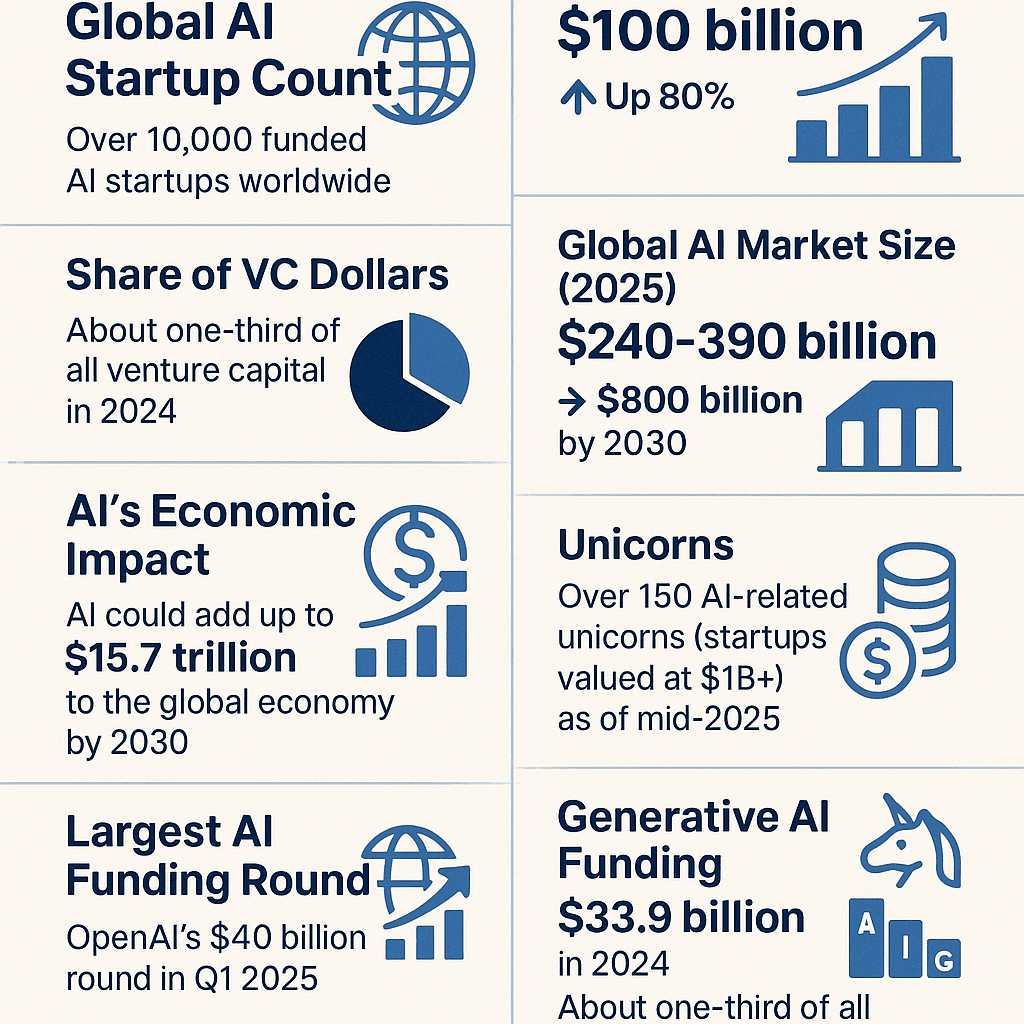
How AI Is Redefining Startup Funding in 2025:Venture Capital’s New Obsession

Introduction — A Turning Point in VC’s Playbook That’s no exaggeration. In the first half of 2025 alone, AI startups captured 53% of global VC funding — a clear signal that we’re no longer in the era of AI hype, but in one of AI capital dominance.If you’re a founder, investor, or simply a tech enthusiast, you must ask: Why is AI the obsession? And how is this seismic shift altering how startups raise, scale, and survive? In this post, you’ll find not just numbers, but fresh perspectives, cautionary tales, and lessons from the frontlines of AI funding in 2025. 1. From Then to Now: A Comparison of Funding Landscapes in AI Startups Traditional Funding Model (Pre-2023) Diverse verticals (fintech, health, SaaS, consumer) shared investor attention. VCs spread bets across 20–30% “moonshots” with AI as one realm among many. Early-stage rounds were abundant; valuations were often permissive with growth assumptions. AI-Driven Frenzy (2024-2025) Feature Traditional VC Era AI-Era 2025 Sector diversification Broad across domains Heavily skewed toward AI Deal size distribution Many small to mid deals Growth in mega-rounds Investor mindset Growth-at-all-costs Emphasis on moats, defensibility Risk appetite More speculative More selective but bold in winners This shift is rewriting rules — not just for AI founders, but for every startup trying to raise capital. 2. Why VCs Are All In on AI Startups in 2025 Infinite Leverage via Scale AI systems can be scaled without equivalent linear cost increases. Once the model is trained, delivering new users often costs marginal compute or storage. That capital leverage is incredibly compelling for VCs. Moats Built on Data & Feedback Loops Many AI startups are built around proprietary datasets, model fine-tuning, and reinforcement loops. The data moat becomes a key differentiator — one that non-AI startups rarely command. Strategic Importance & National Priority AI is now a geopolitical and strategic concern. Governments and enterprises see AI as a core infrastructure layer, increasing budget allocations and policy incentives around it. Disruption Across Verticals Where AI touches — be it healthcare, supply chain, fintech, or logistics — value creation is immense. VCs see AI not as one vertical, but as a force multiplier across sectors. De-risking Through Market Validation Some early AI use cases (e.g., generative AI, LLMs) have already proven demand. The shift from speculative to validated models makes investing less risky compared to pure moonshots. 3. Unique Perspectives & Realities from the Field Founders Must Earn Attention, Not Beg For It I’ve seen multiple pitches in 2025 where founders simply mentioned “AI startup” and expected investor interest. That rarely works anymore. To stand out, you need: A domain-specific problem where AI genuinely adds leverage (not just “use AI for X”). A defensible data acquisition plan. Early traction or demonstration of model effectiveness. Mega-Rounds Skew the Ecosystem While the headlines focus on $100M+ rounds, many early-stage founders are cautioned: “Why bother?” The attraction is pulling capital upward, leaving a vacuum for smaller bets. If you hit product-market fit early, you might also jump directly into a growth round — scaling fast becomes key. Investor Fatigue—But for Non-AI Sectors I’ve personally heard LPs (Limited Partners) question deploying more capital to verticals outside AI. That’s a dangerous signal for promising non-AI startups. Your pitch must be razor-sharp, defensible, and show synergy with AI where possible. Visit More: The Myth of Full Automation Even leading AI founders admit: most of the model-heavy parts are automated, but orchestration, UX, debugging, and operations still need human oversight. Founders who underplay this often overpromise. Exit Routes Become Multi-Modal Because of magnitude and attention, AI startups are more likely to be acquired or pursued via SPAC/IPO than non-AI peers. But now investor expectations include uptime, safety, bias mitigation — not just growth. 4.Key Trends & Strategic Takeaways [AI Startups] Trend 1: Autonomous Agents Take Seed Stage by Storm In AI Startups building AI agents and assistants are seeing outsized seed interest. In early 2025, seed-stage funding skewed strongly toward autonomous AI agents for enterprises. Takeaway: If you’re building agentic systems (workflow, automation, AI helpers), you’re in the sweet spot of VC appetite today. Trend 2: Infrastructure & Tooling Are the Next Frontier While model builders dominate, investment is flowing into tools — observability, deployment, data transformations, prompt engineering. As foundation models homogenize, value will shift toward infrastructure. Takeaway: Founders in this layer may avoid the winner-takes-all trap of model building and tap into broad demand. Trend 3: Overconcentration Risk Too much capital is being concentrated into a few winners. Many VCs now reserve >50% of new funds for AI-centric startups. Takeaway: If you’re non-AI, you need to show tangential synergy with AI or risk being sidelined. Trend 4: Selectivity Replaces Spray-and-Pray Even within AI, not all startups get funded. VCs now demand: Takeaway: Don’t lead with buzzwords — lead with performance, risk controls, and growth path. Trend 5: Rise of Corporate & CVC Participation Corporate venture arms dominate many AI rounds. In 2025, large corporates are investing strategically to secure AI talent, partnerships, and domain advantage. Takeaway: For many founders, aligning with a corporate that shares domain interests can accelerate partnerships and offer stability. 5. What This Means for AI Startups in 2025 6. Conclusion — The Future Is Already Here In 2025, the narrative has flipped: “AI startup” is not a buzzword, it’s a magnet for capital. But with “everyone wants a slice,” only the disciplined, purposeful, and defensible ideas will survive. VCs have evolved — they’re less enamored by pure magic and more drawn to repeatability, safety, and leverage. The landscape rewards builders who think like engineers and strategists at once. If you’re building in AI or adjacent spaces, now is the moment. But the question is: will you merely ride the wave, or will you shape where it breaks?

How AI Is Redefining Startup Funding in 2025:Venture Capital’s New Obsession Read More »

LinkedIn
LinkedIn
Share